
Rope Wrangler
By Andy Kirkpatrick
May 13, 2015
Reading Time:06 minutes.
Warning: All of these articles are decades old, most written in the 1990s! Any references to gear are now seriously outdated, as are mentions of “state-of-the-art” techniques. They are included here because they still hold some value—some fundamentals of climbing never change.
Ropes are both a blessing and a curse. They keep your ass safe, keep you connected, and allow you to get down in one piece, whether you reach the top or only halfway. They can also be a pain in the ass: tangled, snagged, hung up, and always at the worst possible moment.
Good rope management matters. No—excellent rope management matters. Learning to handle ropes well on small routes pays off when things get longer, steeper, and more committing.
If you can develop the skills, mindset, and focus to keep your ropes under control, and deal with them when they misbehave, you’ll save time, reduce stress, and be safer.
Rope management notes
Here are a few things to keep in mind while developing your rope-wrangling skills.
- A rope has two ends. If it has more than two, you’re in trouble (I once went to climb the Harlin on the Eiger with Paul Ramsden only to discover at the first belay that a mouse had eaten halfway through our 100-metre rope).
- A rope has one middle, which should be clearly marked (remark it with Beal marker ink if needed).
- A rope is not sentient. It’s a rope.
- A rope does not wish you well or ill, does not plot against you, and does not enjoy causing stress. It is a tool for fun or disaster.
- A rope is a rope.
With that sorted, it’s time to learn how to handle one. Like taming a lion, it’s best to start with just a single rope.
Beginning with a single rope is the best way to learn rope management, how to avoid drag, deal with edges, and control it in awkward situations. The habits you develop with one rope—proper extension, smooth feeding, anticipating problems—pay off massively when you move to double ropes.
- Although only nylon, treat your rope as if it’s part of the team.
- Look after it. A rope is sensitive. It can hold a car, yet it’s made from strands as thin as hair.
- Standing on a rope isn’t catastrophic, but it’s disrespectful. Don’t do it.
- A rope likes a firm hand. When not moving it should be neatly coiled or stacked, ready for action.
- Never let your rope get away from you. Keep ends close, clip them in on abseil, and keep loops in sight whenever possible.
- Deal with problems early. Spot them before they grow.
- Ropes punish laziness by tangling, snagging, and knocking rocks off ledges.
- Wind and ropes are trouble. The stronger the wind, the firmer your grip needs to be.
You should already know how to coil a rope. A rope bag or tarp is a great investment for single-pitch, sport, or indoor climbing. Always start by uncoiling the rope fully, then feed it into a pile. The belayer should sort the rope while the leader racks up.
The belayer must start stacking from their end so the leader’s end feeds out first. A tarp keeps the rope out of dirt (walls can be filthy too). An alternative is a lightweight plastic bucket or Ikea carrier bag, feeding the rope straight in.
At the top of a single-pitch route, feed the rope behind the belayer into a pile, then coil it for descent. If the walk-off is easy, loop it loosely around your neck without tying so you can drop it at the ground.
Be careful that your rope doesn’t dislodge loose stones onto climbers below.
With double ropes, you’ll end up with a big mixed pile. To avoid tangles, both climbers should split the ropes into two piles, starting from the second’s end. Once you reach the middle marks, coil each rope.
Multi-pitch
The hardest rope management happens on multi-pitch routes. Multiple belays, wind, rain, darkness, and fatigue all conspire to create chaos. Get it right and things flow. Get it wrong and you waste time, energy, and increase risk.
Strategies and tactics
Your system only needs to do one thing: store the rope so it won’t tangle or snag, without distracting you from belaying.
- Stacking directly on your tie-in is simple, but often it’s better to stack away from you using a window in the belay or a bite in the rope. This keeps feet and loops clear and makes swapping leads easier.
- More loops increase the chance of tangles. Longer loops risk snagging or blowing around. Too much dead-rope weight also makes belaying harder.
- In calm weather, use a decreasing loop stack. Start with the longest safe loop, then make each loop slightly shorter. They will feed cleanly.
- If it’s windy, cramped, or dark, use parallel loops of equal length. If they tangle, lift and shake the stack gently.
- Avoid flipping stacks. Either switch ends (while attached) or re-stack from the leader.
- Direct belays like a Petzl Reverso make rope handling much easier.
- If you’re hopeless with ropes, consider a rope bucket or Ikea bag clipped to the anchor.
- If your partner struggles, climb slowly and let them stop you before things tangle.
- When climbing as three, have the third manage the ropes.
- With two seconds, keep them close together or stack ropes separately.
All a tangle
When ropes tangle—and they will—slow down. Don’t panic. Loosen knots, pull things apart methodically, and keep calm. There’s a big difference between sorting a tangle at the wall and sorting one at midnight on a big route.
So there you go. Rope wrangling in a nutshell. Remember: two ends, one middle. How hard can it be?

PV Podcast
Read More

Reflections
Midnight Run
A midnight emergency run across Lough Corrib with a badly burned child—fear, mistakes, and instinct collide in this raw story of risk, parenting, and consequence.By Andy Kirkpatrick

Reflections
G is for Garibotti
A quiet evening in Rolando Garibotti’s Boulder kitchen in 2004 reveals the human side of one of Patagonia’s greatest climbers. A personal reflection on talent, illness, humility, and the day climbing regained its wonder.By Andy Kirkpatrick

Reflections
U is for Unknown Pleasures
What do you really get out of climbing? Not just the views. A deeply personal reflection on the small, unexpected rewards of mountaineering — from frost-nipped fingers and cheap tea to coming home changed.By Andy Kirkpatrick
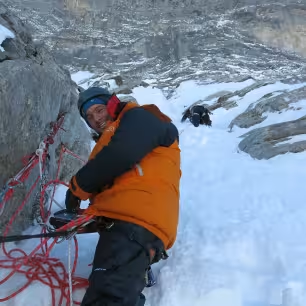
Climbing
GriGri Unconfidential
A raw, honest confession about repeatedly fucking up with the Petzl GriGri — misthreading, open-device rappels, and the psychology of climber errors. Not a gear review, but a deep look at why we all make mistakes and why honesty matters more than looking competent.By Andy Kirkpatrick
Climbing
Beyond Help
When professional rescue isn’t coming: A gripping account of a near-fatal fall in Kenya and a fatal accident in Kalymnos. Essential reading on self-rescue, expectations vs reality, and staying alive in the mountains.By Andy Kirkpatrick

Climbing
Psycho Vertical (2017)
"Psycho Vertical: a raw climbing film about fear, obsession, and pushing into the vertical unknown, where control slips and consequences bite."By Andy Kirkpatrick
Reflections
Brotherhood of Rope
Andy Kirkpatrick returns to climbing after a neglected bicep injury, grappling with ego-bruising restarts, chaotic family crag days, and the raw futility of the sport. Reflections on old friends, near-misses, and the heavy shadow of suicide—including the sudden loss of a charismatic climbing mate and a salvific message from a fallen hero—explore pain, connection, and why words can feel like morphine when life unravels. Intimate, humorous, and unflinching.By Andy Kirkpatrick