
Dark-Half
Down on the Eiger
An honest reflection on attempting a rope-solo of the Eiger Direct: the heavy safety margin, hauling 70kg in poor conditions, blogging from the face, family impact, criticism, failure, stubbornness, and why daring greatly still matters more than success.
By Andy Kirkpatrick
January 6, 2009
Reading Time:04 minutes.
Back on the flat again, and I think it’s time to do some explaining, both about the Eiger attempt and how I set about doing it (blog, filming, etc), as it’s kicked up quite a lot of interest on various websites—primarily on UKC.
First off, let’s get one thing clear—I don’t consider rope soloing the Eiger Direct any big thing beyond that of a personal goal. It’s been soloed many times before, including a 27-hour winter solo by the legendary Slavko Sveticic, and maybe even another slow rope-soloing Brit, Phil Thornhill (although I’m not 100% sure about that). It’s worth saying this, as I can imagine proper climbers (Nick Bullock, etc) grumbling that I’m making a big deal of this. Well, I’m not, and never intended anyone to imagine this was a big deal (if you tried a second winter solo of the Young Spider, it would be).
Secondly, was this a foolhardy attempt?
Well, not the way I was trying it, and because I was aiming for as close to assured safety as possible, that’s why I failed (that’s not to say it isn’t possible).
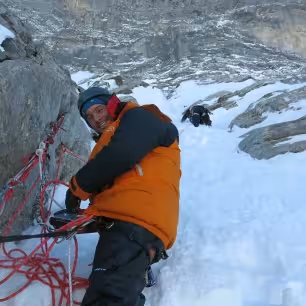
For example, I had a 100-metre 10mm rope, an El Cap–sized rack, a bolt kit (yes—that’s right—but only because the Direct has many old ring bolts and I didn’t want to trust my life to a belay of two bolts placed in the 60s, so I took four 8mm bolts), a portaledge and Exped fly, 10+ days of food and gas, two sleeping bags (one down, one synthetic), a phone, and someone in the valley (Al Lee) keeping an eye on me.
This meant every belay was 100% bomber (most had four pieces), and I could move only when it was safe. I sat for two nights at the bottom waiting for the snow to clear, and could afford to climb very carefully and in total control—which was good, as the snow and ice conditions were not ideal, and an unroped ascent would have been very risky (I slipped down on poor snow a couple of times).
Ultimately what held me back was poor conditions and having to drag up such a load. I only gained 400 metres of height but climbed 800 metres and hauled 70kg of kit through porridge. It wore me out to the point where I judged the safety margin I’d set myself had been crossed. If I’d been climbing with a partner I would have gone on, but when you’re alone and everything comes down to you, you need more in reserve.
Would I try it again? Yes—and I will—only learning from my mistakes. It may have sounded like I was at the end of my tether, but when packing up to bail I stashed all my food and gas for a second go.
As for the blog stuff: I really enjoyed watching Ben Saunders attempt to ski to the North Pole last year, blogging each day as he went. It was voyeuristic, of course, but I found it inspirational. Technology made this easy for me, and having an iPhone meant I could check Swiss weather daily and do a short report in about 60 seconds.
Would I do it again? Ultimately, I think this kind of thing on such a climb is too hard on people who care about you, as they assume that if nothing appears you’re in trouble. In fact, the one night I couldn’t blog was because I spent hours digging around for a 100% secure belay (there are some really bad areas of rock on the Eiger) and was so tired I just crawled into my bed.
Getting emails from my kids was also a killer. Although I knew I was safe, there’s always a risk something could happen—but no more than if I’d stayed in Scotland and gone climbing Grade V on the Ben.
Was I in a fit state to try? Well, no—but then I’ve never been in a fit state to try any climb. When I climbed the Lesueur Route on the North Face of the Dru (Scottish VI/VII, and a damn sight harder than the Eiger Direct), I hadn’t climbed for over a year.
I’m not like Bracey, Powell, Cross, etc, who are genuinely full-time climbers—athletes, if you wish—and would race up a route like the Direct in a few days. I’m an utterly normal person who finds fitting in even a day’s climbing in the ’Gorms difficult, juggling kids, ex-wife and girlfriend, many jobs and commitments—just like about 90% of climbers in the UK.
Call me selfish? It’s because I’ve always tried not to let climbing make me a heartless, climbing-obsessed bastard that gets me into these scrapes in the first place. What I have in my favour isn’t a six-pack or marathon physique (since when did being skinny make you a good mountaineer?), but stubbornness, a willingness to try something difficult with as big a safety margin as possible, and—most importantly—a willingness to fail.
My book and website may have the word psycho in them, but ask anyone who’s climbed with me and you’ll find I’m probably one of the most paranoid climbers around.
Was I stupid to try? Not at all. If I’d had more time (I’m heading to Patagonia on the 17th to go sea kayaking), I’d have come down, rested a few days, sorted my gear, and gone up again to do it. The Direct is primarily short hard sections interspersed with easy climbing—just like the 1938 route.
As it is, I’d be keen to go back alone or with a partner (Joe Simpson said he was keen in an email a few weeks back).
Did I enjoy it? It was an utter ball ache dragging my bag up behind me, and the stress of stressing out my loved ones was hard. But how could any alpinist, given the chance to climb on the Eiger in winter—to scratch up limestone chimneys and buttresses, to find shelter under its skin of ice and snow each night, to have the whole face to yourself—not feel like the luckiest person alive, and that the risk is worth it?
So thanks to everyone who blogged, emailed, and defended the indefensible. I’ll leave the last words to someone else (emailed to me by Paul Deegan).
It is not the critic who counts,
Nor the man who points out how
the strong man stumbles
Or where the doer of deeds
Could have done better.
The credit belongs to the man
Who is actually in the arena;
Whose face is marred by dust
And sweat and blood;
Who knows great enthusiasm,
Great devotion and the triumph
of achievement.
And who, at the worst, if he fails
At least fails while daring greatly—
So that his place shall never be
With those odd and timid souls
Who know neither victory nor defeat.
You've never lived until you've almost died.
For those who have had to fight for it,
Life truly has a flavour
The protected shall never know.
—Theodore Roosevelt
Citizenship in a Republic,
23 April 1910, the Sorbonne, Paris
Anyway, it makes you think, doesn’t it…
PV Podcast
Read More
Reflections
Midnight Run
A midnight emergency run across Lough Corrib with a badly burned child—fear, mistakes, and instinct collide in this raw story of risk, parenting, and consequence.By Andy Kirkpatrick
Reflections
G is for Garibotti
A quiet evening in Rolando Garibotti’s Boulder kitchen in 2004 reveals the human side of one of Patagonia’s greatest climbers. A personal reflection on talent, illness, humility, and the day climbing regained its wonder.By Andy Kirkpatrick
Reflections
U is for Unknown Pleasures
What do you really get out of climbing? Not just the views. A deeply personal reflection on the small, unexpected rewards of mountaineering — from frost-nipped fingers and cheap tea to coming home changed.By Andy Kirkpatrick
Climbing
GriGri Unconfidential
A raw, honest confession about repeatedly fucking up with the Petzl GriGri — misthreading, open-device rappels, and the psychology of climber errors. Not a gear review, but a deep look at why we all make mistakes and why honesty matters more than looking competent.By Andy Kirkpatrick
Climbing
Beyond Help
When professional rescue isn’t coming: A gripping account of a near-fatal fall in Kenya and a fatal accident in Kalymnos. Essential reading on self-rescue, expectations vs reality, and staying alive in the mountains.By Andy Kirkpatrick

Climbing
Psycho Vertical (2017)
"Psycho Vertical: a raw climbing film about fear, obsession, and pushing into the vertical unknown, where control slips and consequences bite."By Andy Kirkpatrick
Reflections
Brotherhood of Rope
Andy Kirkpatrick returns to climbing after a neglected bicep injury, grappling with ego-bruising restarts, chaotic family crag days, and the raw futility of the sport. Reflections on old friends, near-misses, and the heavy shadow of suicide—including the sudden loss of a charismatic climbing mate and a salvific message from a fallen hero—explore pain, connection, and why words can feel like morphine when life unravels. Intimate, humorous, and unflinching.By Andy Kirkpatrick