
Dark-Half
The Invisible Wall
A reflection on invisible walls, self-censorship, and the tension between free speech, fear, and social control in modern society.
By Andy Kirkpatrick
September 15, 2018
Reading Time:02 minutes.
Once heard a story about the North Koreans building an invisible wall, 5m high, 10m thick, that ran for 240km across the DMZ, designed to protect its people from the South. It was said that North Koreans would look out at this invisible wall and believe it was there because their Supreme Commander said so. Doubt leads to hard labour.
I find people who scoff at the idea of self-censorship and control lack self-awareness, because we all do it. It’s how we survive. Although we’re parroting our own particular Supreme Commanders and their organs, we doubt we are being controlled because it is the only position any right-thinking person could take. To even question or doubt, to ask for proof of invisible walls, makes you suspect, even to yourself.
In Ireland, people don’t self-censor, and the other day, when an 80-year-old relation was mugged — the kind of mugging that kills the old slowly, makes them prisoners in their homes forevermore — the angry consensus was it must have been a “traveller, or a Lithuanian”, an open conversation I doubt people have in the UK, where even mass murder would not draw out the words “Nigerian” or “Somalian” from polite society in search of an answer, only “Brexit” or “austerity”. A MET officer once told me that fear of being seen as racist empowers gangs, not to respond to the problem, but instead to do and say and think and act in a way that allows them to get on. But it’s not a means without ends. It rots society — well, society that cannot afford private security. The poor always suffer for our high ideals.
Do these words make sense, or are they ridiculous?
I saw this morning that a senior policeman has been suspended for using the term “whiter than white”, the charge against him being the use of language deliberately intended to offend and that had racist undertones. They caught the mugger. He was a traveller.
Turns out the invisible wall exists: 5m high, 10m thick, 240km long. Invisible to the free world due to earth being banked all the way to the top of the South side, meaning South Korean soldiers could easily walk up to the top. Like many such walls in the last two centuries, the blocks were bigger on the inside.
PV Podcast
Read More
Reflections
Midnight Run
A midnight emergency run across Lough Corrib with a badly burned child—fear, mistakes, and instinct collide in this raw story of risk, parenting, and consequence.By Andy Kirkpatrick
Reflections
G is for Garibotti
A quiet evening in Rolando Garibotti’s Boulder kitchen in 2004 reveals the human side of one of Patagonia’s greatest climbers. A personal reflection on talent, illness, humility, and the day climbing regained its wonder.By Andy Kirkpatrick
Reflections
U is for Unknown Pleasures
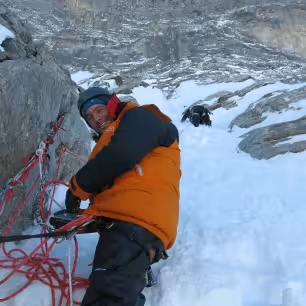
What do you really get out of climbing? Not just the views. A deeply personal reflection on the small, unexpected rewards of mountaineering — from frost-nipped fingers and cheap tea to coming home changed.By Andy Kirkpatrick
Climbing
GriGri Unconfidential
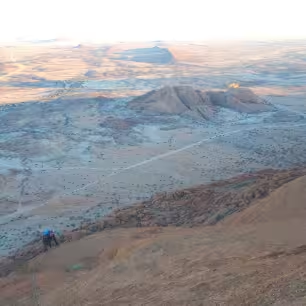
A raw, honest confession about repeatedly fucking up with the Petzl GriGri — misthreading, open-device rappels, and the psychology of climber errors. Not a gear review, but a deep look at why we all make mistakes and why honesty matters more than looking competent.By Andy Kirkpatrick
Climbing
Beyond Help
When professional rescue isn’t coming: A gripping account of a near-fatal fall in Kenya and a fatal accident in Kalymnos. Essential reading on self-rescue, expectations vs reality, and staying alive in the mountains.By Andy Kirkpatrick
Climbing
Psycho Vertical (2017)
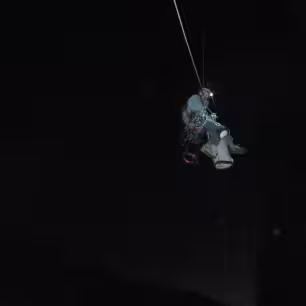
"Psycho Vertical: a raw climbing film about fear, obsession, and pushing into the vertical unknown, where control slips and consequences bite."By Andy Kirkpatrick
Reflections
Brotherhood of Rope
Andy Kirkpatrick returns to climbing after a neglected bicep injury, grappling with ego-bruising restarts, chaotic family crag days, and the raw futility of the sport. Reflections on old friends, near-misses, and the heavy shadow of suicide—including the sudden loss of a charismatic climbing mate and a salvific message from a fallen hero—explore pain, connection, and why words can feel like morphine when life unravels. Intimate, humorous, and unflinching.By Andy Kirkpatrick